Building climate resilience of communities through data management
Climate resilience of communities is not only about major strategies, but also about everyday decisions. For example, when to take children outside, where to plant a tree, how to modify a school yard, or how to adjust a housing-estate route. In order for these decisions not to be based only on feelings, we need local evidence – precise, regular, and clearly explained data.
This is exactly what systematic climate data management brings: the collection of reliable measurements, their secure transfer, open sharing, and interpretation into simple recommendations for people and municipalities. In this way, data become the basis for quick micro-steps as well as long-term investments supporting climate resilience of communities, such as the shading function of greenery or permeable surfaces.
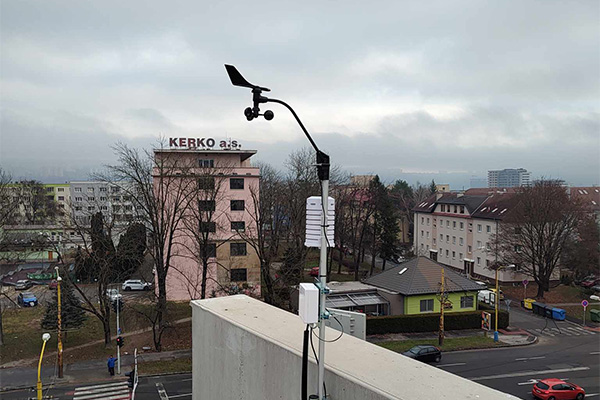
Within MISSION CE CLIMATE, climate stations were installed in Košice in January 2025 at seven primary schools.
Within MISSION CE CLIMATE, climate stations were installed in Košice in January 2025 at seven primary schools: Požiarnická Primary School, Staničná Primary School, Gemerská Primary School, Hroncova Primary School, Tomášikova Primary School, L. Novomeský Square Primary School, and Park Angelinum Primary School.
Climate station
The sensors continuously monitor dust levels, air quality, temperature, and wind dynamics, thus creating a local climate footprint of individual courtyards and streets.
The values of these indicators are visualised through the public Climate Datadashboard, which not only displays graphs of indicator development, but also explains the health and environmental context, recommended behaviour, and typical values of each indicator.
The goal is to translate “raw” measurements into understandable signals for everyday decision-making and planning.
The pilot project brings not only digital technology, but also an educational programme with worksheets for physics, biology, chemistry, and civics. The goal of this programme is for pupils to work with climate-indicator data from the sensors of “their” school, thereby supporting their digital competences while teachers also meet the required educational objectives. This element turns data into an everyday habit and builds a long-term culture of climate literacy in the community.
Within the MISSION CE CLIMATE project, other interesting pilot projects for increasing the climate resilience of communities were also implemented in Austria, Germany, Slovenia, Croatia, and Italy.